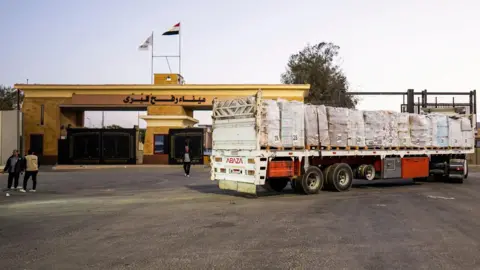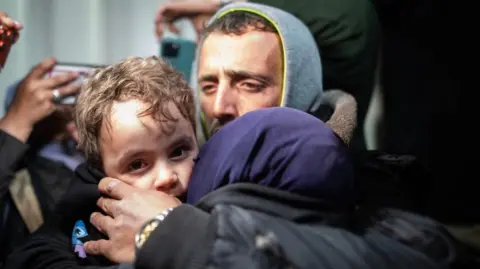
Two Gazan women who passed through the newly reopened Rafah crossing with Egypt on Monday shared their unsettling experiences of security checks conducted by a local Palestinian militia known as the Abu Shabab. Traveling with their children, they were escorted by Israeli forces to a checkpoint, where they underwent a scrutiny by the militia before being handed over to the Israel Defense Forces (IDF) for further questioning.
Lamia Rabia described the searches conducted by a female militia member and highlighted that the militia simply searched their belongings without communication, a process that felt intimidating.
The claims raised concerns regarding coordination between the IDF and Abu Shabab, prompting inquiries from the BBC to both entities; however, the IDF declined to comment on the militia's involvement. The Abu Shabab militia operates under Israeli military control and has been known for its role in the region, claiming to provide security amidst ongoing tensions.
Rabia also recounted mistreatment, alleging that she and others faced abuse and coercion from militia members with threats of violence. Despite these alarming claims, another woman noted her experience was surprisingly smooth.
The European Union, which has monitors at the crossing, is considering measures to ensure the safety of its citizens in light of such reports. The situation at the Rafah crossing continues to evolve as fears loom surrounding the humanitarian implications for the 20,000 Gazans in dire need of medical care abroad, many of whom are hoping for the chance to travel out of the territory.
Misunderstandings and security delays have thwarted efforts, with only 12 individuals managing to cross on Monday despite pre-approval from both Egyptian and Israeli authorities for 50 evacuees. The World Health Organization reports significant gaps in safe passage and the ongoing urgency for medical evacuations, amidst fluctuating protocols that challenge the authority of groups overseeing the crossing operations.
Lamia Rabia described the searches conducted by a female militia member and highlighted that the militia simply searched their belongings without communication, a process that felt intimidating.
The claims raised concerns regarding coordination between the IDF and Abu Shabab, prompting inquiries from the BBC to both entities; however, the IDF declined to comment on the militia's involvement. The Abu Shabab militia operates under Israeli military control and has been known for its role in the region, claiming to provide security amidst ongoing tensions.
Rabia also recounted mistreatment, alleging that she and others faced abuse and coercion from militia members with threats of violence. Despite these alarming claims, another woman noted her experience was surprisingly smooth.
The European Union, which has monitors at the crossing, is considering measures to ensure the safety of its citizens in light of such reports. The situation at the Rafah crossing continues to evolve as fears loom surrounding the humanitarian implications for the 20,000 Gazans in dire need of medical care abroad, many of whom are hoping for the chance to travel out of the territory.
Misunderstandings and security delays have thwarted efforts, with only 12 individuals managing to cross on Monday despite pre-approval from both Egyptian and Israeli authorities for 50 evacuees. The World Health Organization reports significant gaps in safe passage and the ongoing urgency for medical evacuations, amidst fluctuating protocols that challenge the authority of groups overseeing the crossing operations.