
In brief
In Tiruppur, a significant textile export hub, business owners are grappling with the effects of a 50% tariff imposed by the US on Indian goods. With orders halted and expansion plans paused, the pulse of the garment industry is at risk. The tariffs threaten to undermine years of trade relations as factories struggle to operate and meet salaries amidst declining demand. As industries brace for the future, the fears of losing substantial market share to competitors in neighboring countries loom large.
'How will I pay workers?': Indian factories hit hard by Trump's 50% tariffs
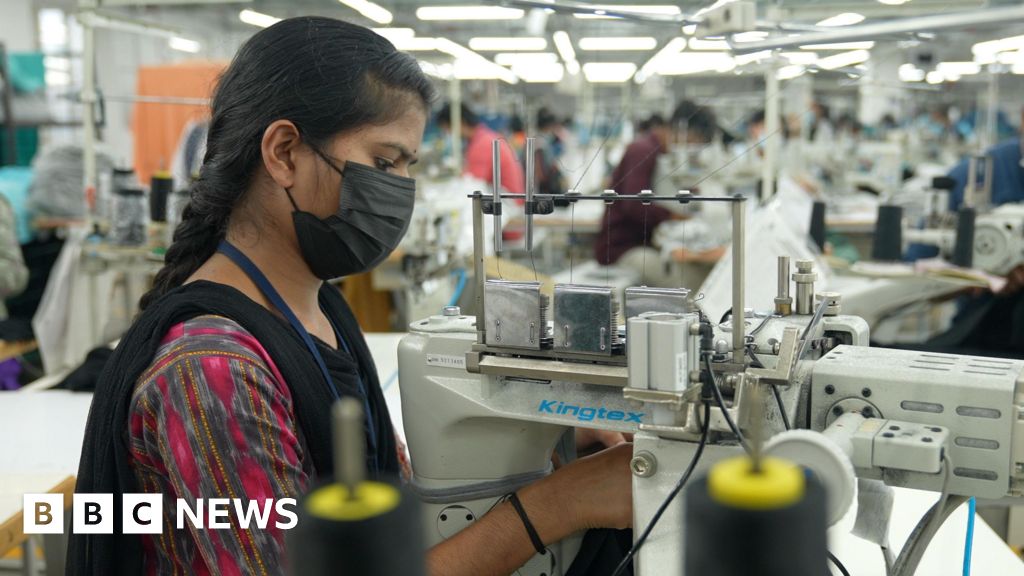
An eerie silence hangs over N Krishnamurthy's garment manufacturing unit in Tiruppur, one of India's largest textile export hubs. Only a fraction of some 200 industrial sewing machines on the floor are in operation, as workers make the last of the season's children's garment orders for some of the biggest US retailers.
At one end of the room, piles of fabric samples for new designs are gathering dust - casualties of US President Donald Trump's steep 50% tariffs on India, set to kick in from Wednesday. India is a major exporter of goods, including garments, shrimp, and gems and jewellery, to the US. Trade experts say the high tariffs - including a 25% penalty for buying Russian oil and weapons - are akin to an embargo on Indian goods.
BBC correspondents visited key export hubs across India to assess how the trade uncertainties are impacting business owners and livelihoods. Across Tiruppur, which contributes to a third of India's $16bn exports of ready-to-wear garments to brands such as Target, Walmart, Gap, and Zara, there's acute anxiety about what the future holds.
September onwards, there may be nothing left to do, Krishnamurthy said, as clients have paused all orders. He recently had to pause his expansion plans and bench nearly 250 new workers who were hired before the tariffs were imposed.
The timing of the announcement has made things worse because nearly half of annual sales for most export businesses are made during this period, in the run-up to Christmas. Now these units are banking on the domestic market and on the upcoming Diwali season in India, to survive.
At another factory that makes underwear, we saw inventory of nearly $1m, meant for US stores, piled up with no takers. We were hoping India will ink a trade deal with the US. The entire production chain was frozen last month. How will I pay workers if this continues? Siva Subramaniam, the owner of Raft Garments, told the BBC.
At a 50% tariff rate, an Indian-made shirt that once sold at $10 will cost US buyers $16.4 - far costlier than $14.2 from China, $13.2 from Bangladesh, or $12 from Vietnam. Even if duties ease to 25%, India will be less competitive than its Asian peers.
To soften the blow, the government has announced some measures - a suspension of import duties on raw materials, for instance. Trade talks with other countries have also gathered momentum to diversify markets. But many fear this is too little, too late.
We can expect the diversion of trade, with US buyers moving to Mexico, Vietnam, and Bangladesh, said Ajay Srivastava of the Global Trade Research Initiative.

