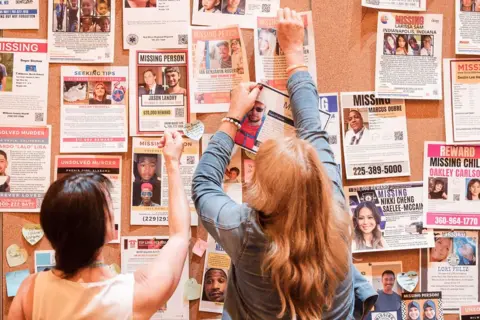
Los Angeles-style bright lights hovered over the MGM Grand’s convention halls as CrimeCon 2026 opened, drawing 6,500 true‑crime fans, podcasters, lawyers and families along with a handful of celebrities who had been thrust into the spotlight by the media’s relentless focus on the darker side of humanity.
For most attendees, the lure was an authentic curiosity about criminal investigations, human behaviour and, for some, a way to sharpen a personal safety toolkit. — — And yet, for the more than a dozen victims’ families at the event, the wall of missing‑people posters and advocacy booths felt like a stage on which the true‑crime narrative was being played for a captive audience.
Dr. Maggie Zingman, a trauma psychologist from Las Vegas, marched beside her gallery of Brittany Phillips’s photographs. In 2004 Brittany was murdered, and her case has never been solved. Her presence—loudly rolling a pink SUV that turned heads—made the try to get her daughter’s story in the national conversation a top priority. She said, “It’s a balance. I wouldn’t get 8,000 people learning about my story if it wasn’t here.”
Meanwhile, families of high‑profile victims—such as that of Kaylee Goncalves, murdered in Idaho by Bryan Kohberger—were made to feel both acknowledged and eclipsed. Greg Wallace, a father of an eight‑year‑old missing daughter, expressed a mixture of hope and dread. “I’ve got her name out there globally now, and that just gives me more hope,” he told the crowd, his portrait of the missing child framed by sunflower motifs on his shirt.
“The event tries to pay right to nobody; it’s focused on victims,” according to Zingman, who sees the conference as a platform she requires to bring Brittany’s story to the world. “If it’s a market, then it’s a market,” she added.
CrimeCon’s pop‑culture framing comes hand‑in‑hand with thriving merchandising; wall‑tight tees proclaiming “True Crime & Wine” or “I’m Only Here For An Alibi” ride the wave of a seemingly commercial spectacle. Behind the neon signage, however, are countless foundations seeking to raise public awareness about missing persons and domestic violence.
Among the chatter, a woman sporting crime‑scene‑tape leggings was joined by hosts who offered theories over well‑known cases and a “Clue Awards” ceremony honoring survivors and related nonprofits.
The event was not free from criticism. “Many say that the content focuses on perpetrators rather than victims, and that the cruelty of the genre is being monetised,” explained an event co‑founder. He added, “I’m proud that the conference primarily focuses on what’s going wrong for victims, not how the killers are glorified.”
For a young woman who lost her mother to the victim impact, and who is thus passionate about public safety, the conference was a learning experience: “I know how to identify suspicious behaviour when it’s a real danger, not a TV episode.”
In the meta‑irony of the case, the name “CrimeCon” echoes the famous “Comic Con” phenomenon—a comparison that some attendees disliked, but a survivor clarified: “I see this as a place to learn something about human behaviour, the complexity of crimes.”
Please note: the event’s current partnership with Fox News—an acquisition of the original production company in 2025—further speaks to the growing corporate investment in true‑crime narratives.
As CrimeCon approaches its third decade, the community holds an evolving conversation: a mix of entertainment, advocacy, commercialization and a deep respect for the reality that, at its core, these stories revolve around living families, not just entertainment.