Democrats already had a lot to worry about in the 2026 California governor's race, an election they would typically expect to win easily: Too many candidates. Low name recognition. Voter apathy.
Then on Sunday, their leading candidate, Representative Eric Swalwell, faced with allegations of sexual assault and misconduct, dropped out of the contest, even as he denied the accusations. His exit threw the Democrats into further chaos and left the party facing a previously unthinkable possibility: could Republicans shut them entirely out of the general election in one of the bluest states in the US?
This would be an unforced error of historic proportions if Democrats fail to coordinate so badly that a Republican wins in a state where Donald Trump's approval rating is a little less than 30%, said Eric Schickler, a political science professor at the University of California, Berkeley.
The San Francisco Chronicle and CNN last week published allegations by several women about Swalwell's conduct, leading his most prominent backers to abandon him. On Monday, Swalwell announced he would resign from Congress, hours after the US House of Representatives Ethics Committee opened an investigation. Swalwell has apologized for the mistakes in judgment I've made in my past but vowed to fight the serious, false allegations that have been made.
But Democrats' problems in California began long before those accusations became public. Sitting Democratic Governor Gavin Newsom cannot run again due to term limit rules, and other politicians with statewide name recognition – such as former Vice-President Kamala Harris – declined to run. Eight serious but lesser-known candidates have struggled to gain traction in California's enormous and expensive media market.
In March, an opinion poll by University of California Berkeley's Institute of Governmental Studies caused a political earthquake, suggesting that two Republican candidates were garnering the most support among voters as the packed field of Democrats had splintered their base.
Thanks to California's primary system - which allows the top two vote-winners to compete in the general election regardless of party - such a result in June could mean there aren't any Democrats on the gubernatorial ballot in November, in a state that hasn't had a Republican governor since Arnold Schwarzenegger left office in 2011.
The outcome of the race could have implications for Democrats beyond California's borders. The state is the fifth-largest economy in the world, and its environmental, consumer, and tech policies often inspire regulations nationwide.
Swalwell had started to gain momentum in recent weeks, breaking out from the Democratic pack. State Democrats had hoped he could surge enough to guarantee them a spot in the general election. But with Swalwell gone, it's unclear which candidate could absorb his momentum.
This is the most unsettled race for California governor I've ever seen, said Garry South, a long-time Democratic strategist who has managed four gubernatorial campaigns in the state. The Democratic field was already pretty muddled, even after Swalwell took a small lead. Now, it's just an outright morass.
The two candidates best positioned to capture Swalwell's voters and give the Democrats a chance to compete in the general election are former Congresswoman Katie Porter and billionaire climate advocate Tom Steyer.
Still, neither are a sure bet. Porter has previously faced reports from Politico that she allegedly mistreated staff, after which she said she would be more intentional in showing gratitude to my staff. Steyer has spent $89 million on advertisements, but has not yet seen a corresponding surge in opinion polls.
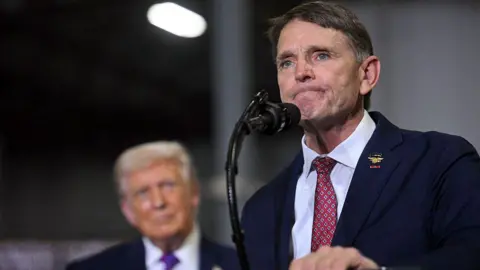
Even as the Democrats struggle, California Republicans are dealing with their own frustrations. The two leading Republican candidates are former Fox News host and one-time David Cameron adviser Steve Hilton, and Riverside County Sheriff Chad Bianco. The March Berkeley poll indicated that Republican voters were evenly split between the two.
I think it's fair for Democrats to be concerned now because their presumptive front-runner has now imploded, said Wesley Hussey, a political science professor at Sacramento State University. But if a large share of Swalwell's supporters move to back Steyer or Porter – or even a last-minute surprise candidate - the state could still see a traditional Democrat-versus-Republican general election after all.